01 — How we work
Outdoor & Transit.
Large-format and transit media across 39 Indian markets, planned around how a city actually moves rather than around what happens to be free this month.
The decision
Three times on one commute beats once across a city.
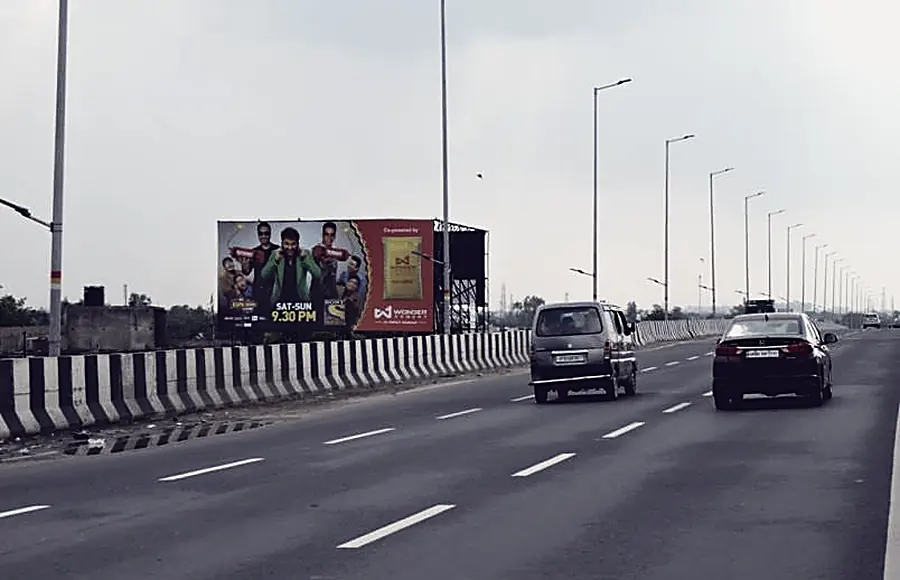
Why it is worth planning
Outdoor is the only medium a person cannot close, skip or scroll past. That is its whole advantage, and it is squandered the moment a plan is built from an availability list instead of from a route. Two hoardings can carry identical rate cards and identical claimed impressions while one sits on a corridor a million people commit to every morning and the other sits on a road they take when the first is blocked.
So the first question is never which sites are free. It is which movements the brand needs to intercept — the commute, the school run, the weekend retail trip, the approach to a dealership — and which structures sit on those movements at the moment attention is available rather than at the moment traffic is heaviest. A site at a signal where vehicles stop for ninety seconds is a different product from a site on a flyover taken at speed, and it should not be bought as though it were the same thing.
The vocabulary matters because the paperwork uses it. A hoarding, a unipole and a gantry are licensed differently in most Indian cities; a bus queue shelter and a pole kiosk sit on municipal street furniture and a different permission file. Sky-sign and advertisement tax are the heads a corporation actually invoices against — not 'billboard'. We plan in that language because that is the language the licence is written in, and because flexing, mounting, illumination and monitoring photographs are the production steps that decide whether what was booked is what a passer-by actually sees.
What we plan
Categories, not a holding.
Typical sizes and how the market buys them. None of this is a site we hold.
- Hoarding
- 40 × 20 ft
- Unipole
- 50 × 20 ft
- Gantry
- spans the carriageway
- Bus queue shelter
- backlit panel
- Bus back and bus side
- 10 × 8 ft
- Pole kiosk
- 3 × 6 ft, in runs
- Auto and cab branding
- by fleet
How the buy is made
The part that decides whether it works.
- 01
Corridor before site
We map the arterial routes, commuter flows and retail approaches that carry the audience you are actually buying, then look for structures on them. The site list is an output of that work, not the input to it.
- 02
Dwell, not just volume
Traffic count is the number every vendor leads with and the weakest of the signals. Signal position, approach angle, viewing distance, height above the roadline and what else is competing in the same field of view decide whether a passing vehicle registers anything at all.
- 03
Frequency over spread
A brand that appears three times on one commute is remembered. The same budget spread thinly across a city is not. We would rather own a corridor for a month than dust the whole map for a fortnight, and we will argue for that.
- 04
Transit as the connective layer
Bus exteriors, cab branding and station media move through the catchments the static sites anchor. Used together they turn a fixed presence into something that follows the audience; used alone they are a cheaper way to be forgotten.
If a word above was doing work you had to guess at
When it earns its place
Concrete situations, not a menu.
- 01A launch or a defence in a city you can name, where the audience moves on a small number of corridors rather than everywhere at once.
- 02A retail or dealership catchment that people approach on the same roads every week — outdoor on those approaches, not a city-wide dusting.
- 03A brand that can hold a corridor long enough for the commute to see it more than once. Continuity is the product; a fortnight is usually a teaser, not a plan.
- 04A transit layer that has something static to connect to. Bus and cab media earn their keep when they pass the same catchments the hoardings hold.
- 05A market where permission is the constraint as much as the structure is — sky-sign rules and advertisement tax change what can actually go up, and a plan that ignores that is a plan that slips.
When to spend it elsewhere
We would rather say so early.
If you need a measurable click within a fortnight, buy performance media instead. Outdoor builds familiarity and salience, and it needs continuity to do it. We will tell you when a short outdoor burst is the wrong instrument rather than sell you one.
What lands on your desk
Documented, not described.
Every campaign ends with a file you can hand to someone who was not in the room.
- A corridor and catchment rationale before any site is proposed
- Site-by-site reasoning — position, approach, competing sightlines
- Negotiated rates with the media owner, disclosed to you
- Mounting and printing managed, with proofing before display
- Geo-tagged, dated photographs of every placement once live
- Mid-campaign condition checks and a post-campaign report
Questions that actually get asked
Including the ones about cost.
How much does hoarding advertising cost in an Indian city?
+
It depends on the corridor, the side of the road, the height and angle, the illumination, the permission file, the production (flexing and mounting), and how long you hold it — not on a city average. We will show you the variables that move a negotiation in your market. We will not publish a number that would be wrong the moment the next tender or the next season lands.
Do you own the hoardings?
+
No. We plan, negotiate and run. The structure belongs to a media owner who holds it under a lease, a licence or a municipal tender. Independence from any one owner is the reason we can argue for the corridor you need rather than the inventory they need to fill.
What is the difference between a hoarding, a unipole and a gantry?
+
A hoarding is a large panel on a roadside, rooftop or wall structure. A unipole is a single-pole structure, usually taller and read from further away. A gantry spans the carriageway, so both directions see it and the permission is almost always a different file. They are not interchangeable products, and they are not licensed as one.
How do you prove the campaign actually ran?
+
Dated, geo-tagged monitoring photographs of every placement once live, plus mid-campaign condition checks. Non-delivery is the fear this industry has earned. A photograph with a stamp is a duller answer than a case study, and a better one.
How long should an outdoor campaign run?
+
Long enough for the same commute to see it more than once. A month on one corridor usually beats a fortnight across a city. Seasonal windows — wedding, festival, exam, harvest — change the answer, and they change it differently in Kanpur than they do in Kochi.
Who licenses outdoor in an Indian city?
+
The municipal corporation, a development authority, or both, under heads that are usually called sky-sign or advertisement tax. The issuing body and the bye-law differ by city. Where we have read the current rule we say so on the city page; where we have not, we say we have not, rather than invent a licence we have not seen.
The rest of the plan
Most plans use more than one.
Outdoor holds the corridor. Transit follows the commute. DOOH takes the hours that a printed face cannot change. Retail and activations sit at the end of the same journey, where someone can actually walk in.
- 02
Digital Out-of-Home
LED and programmatic DOOH, bought by daypart and location.
Read → - 03
Retail & Hyperlocal
Mall, multiplex, society lift and store-catchment media.
Read → - 04
Broadcast, Print & Cinema
News television, radio, national dailies and on-screen.
Read → - 05
Activations & Corporate Gifting
When the plan needs a person in the place, not only a board.
Read → - 06
Barter & Trade Structuring
When the media plan is right and cash is the constraint.
How barter works →